
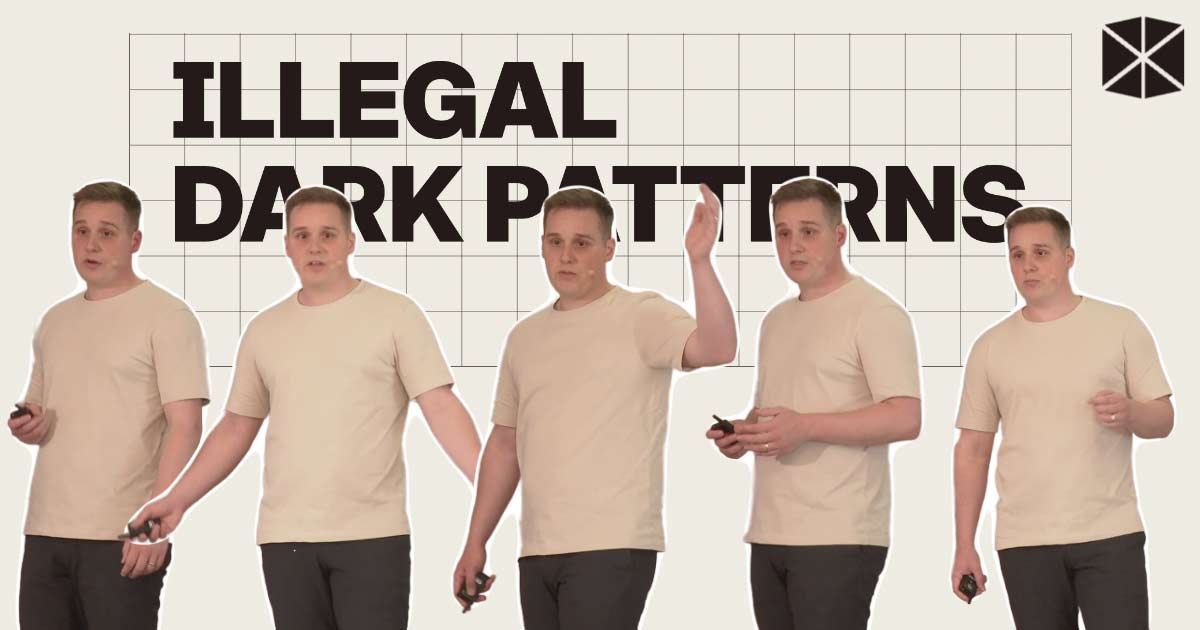
In an era where the digital landscape is constantly evolving, Karel Navrátil’s eye-opening presentation at WebExpo 2025 brought to light the insidious nature of dark patterns in user interface design. As both a lawyer and a front-end designer, Karel provided attendees with crucial examples and insights on how to discern the fine line between legitimate motivation and illegal manipulation that exploits unsuspecting users.

Understanding dark patterns
Karel opened his talk with a clear and concise definition that resonated with everyone in attendance: “A dark pattern is a UI element that tricks or manipulates a user to do something that wasn’t originally his or her purpose.” This definition not only summarises the concept but also underscores its prevalence in everyday digital experiences.
He elaborated with relatable examples, illustrating how users often fall prey to deceptive design choices. Karel described a common scenario: “You are hungry and you just want the food as soon as possible. And just before you click the biggest button, order food, you see it: the hidden fee. And it wasn’t there before. But it’s too late. You fell for the dark pattern.” This example clearly delineates the urgency and emotional state of users, making it easier to understand how dark patterns take advantage of human psychology.
Types of illegal dark patterns across the EU
As Karel dove deeper into the concept of dark patterns, he identified several types that fall on the wrong side of legality within the European Union context. He explained that hidden fees, misleading cookie consent banners, and even fake time-limited offers could lead to serious violations of regulations like the General Data Protection Regulation (GDPR) and the Unfair Commercial Practices Directive (UCPD).
Karel pointed out a classic dark pattern: “There is something missing. This ‘time-limited offer’ doesn’t state whether it ends in an hour, a day, a week, or a month.” Such vagueness isn’t just misleading under EU law; it can cost companies dearly, with fines of up to 20 million euros or 4% of global annual turnover.

Throughout his talk, Karel paired crisp legal interpretations with practical design advice, showing how the law lives not only in written text but also in the way information is visually presented. His goal was clear: to equip both designers and marketers with the knowledge to create experiences that are persuasive without crossing into deception.
Legal insights for designers
Karel’s dual background uniquely positioned him to bridge the gap between design and legal implications. He proposed a new approach to thinking about design, one that integrates a legal mindset at the very outset of the creative process. “Activate your legal mode from the beginning already in Figma files and think about dark patterns throughout all your design process,” he advised the audience.
To help give more detail throughout the presentation, Karel introduced his concept of “legal layers,” pop-up boxes when ‘legal mode is on’ to summarise why a dark pattern is illegal, what regulation it infringes, and potential fines. “For those of you who prefer written text, I prepared these pop-up windows or boxes,” he explained. This innovative format serves to reinforce crucial legal principles without overwhelming designers with jargon. And there’s no shortage of these examples in his weighty talk delivered with a light tone.

The future of dark patterns
Karel concluded his session by exploring the future landscape of digital design and its potential vulnerabilities. With the rise of virtual reality (VR) and augmented reality (AR), he foresees a new frontier for dark patterns. “I imagine that we will experience the digital world in full width through VR or AR glasses,” Karel predicted, foreshadowing the possible complexities that these immersive environments could introduce.
He also drew attention to current trends in advertising where designers and marketers deliberately manipulate our peripheral vision with flickering, moving banner ads. These tactics undermine user autonomy and remain a persistent challenge.

Fundamental questions for responsible design
As a practical takeaway for attendees, Karel provided five key questions that help teams check whether their designs meet both ethical and legal standards. They act as a simple diagnostic tool for guiding more responsible design decisions:
- Is it clear what happens after clicking the button?
- Are we offering real choice or just an illusion?
- Can the user easily say no?
- Are all key details easily visible, like price, fees, etc.?
- Are we honest about how and why we use personal data?
Karel Navrátil’s presentation at WebExpo highlighted a critical intersection of law and design, providing a roadmap to identify and avoid illegal manipulation in user experiences. For the full picture, complete with case examples, see his recording and slides below.