
You are not just using AI anymore. You are making decisions about it: how to evaluate what it produces, how to build the infrastructure beneath it, how to get your organisation to actually adopt it, and how to stay visible in a world where the search engine writes its own answers.
At WebExpo 2026, AI is not a single track. It runs through the entire program, hitting developers, designers, tech leaders, and marketers from different angles. Here is a curated eight, matched by discipline. The full AI lineup runs considerably deeper.

Under the hood
For developers
The model is just the engine. What matters now is the context, the tooling, and the infrastructure you wrap around it.
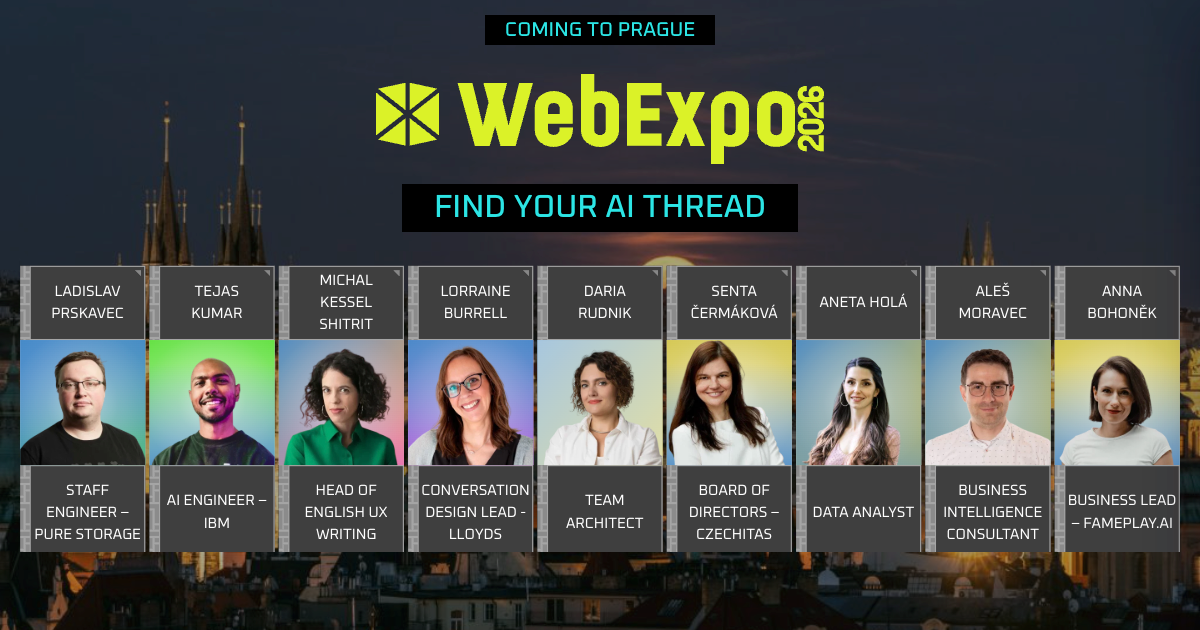
MCP servers are multiplying fast, but there is a difference between wiring one up and understanding what is actually happening inside it. In Under the hood of AI: Building your own MCP server in Go, Ladislav Prskavec will build one from scratch, live alongside an AI assistant, working through tool exposure, API bridging, and what it takes to make your coding agent genuinely extensible.
Most AI integrations are a thin wrapper over an API call. The good ones treat streaming, rendering, and progressive enhancement as first-class concerns. In this code-heavy session, Taste: How performance and other factors make everything, especially AI, better, Tejas Kumar will get into the performance decisions that separate useful AI from forgettable AI.
Tejas is doubling down with a half-day premium workshop, Applied AI engineering: beyond the prompt. Context engineering, RAG, OpenClaw, and autonomous agents. Upgrade your path from AI user to AI builder.

The human layer
For designers and content creators
AI has made output cheap. Judgement has never been more valuable.
The generation part is solved. The evaluation part is not. In Don’t trust the bot: A human framework for evaluating AI copy, Michal Kessel Shitrit will give you a five-principle framework: clarity, next-step guidance, reassurance, user language, and value communication. Walk away knowing what to accept, what to rewrite, and where human input still matters.
Michal is also running a full-day premium workshop, Content design in complex systems for non-writers. If you work on enterprise platforms, dashboards, or data-heavy products, this is how you build a content design system that holds up and use AI tools without losing clarity or consistency.

Designing for AI agents is not the same as designing for predictable user flows. The system branches, fails quietly, and makes decisions you did not anticipate. In Designing the agentic era: Experimentation over magic, Lorraine Burrell will make the case for structured experimentation over perfect plans, and lay out what rigorous agent design actually looks like in practice.
The adoption problem
For tech leaders and PMs
The technology is not the problem.
As AI absorbs more of the routine, what makes a team high-performing shifts fast. In Partnering with AI: Building future-ready teams, Daria Rudnik will focus on the three capabilities that grow more critical as AI handles more of the work: adaptive learning, collaborative intelligence, and emotional intelligence.
You already know the adoption curve looks different across your company. In Fossils, Rockets, and Octopuses: A leadership framework for AI adoption, Senta Čermáková will introduce the Six Tribes of AI Users: from Fossils dug firmly in to Octopuses treating AI as a genuine strategic partner. The framework maps where each person on your team sits and what it takes to move the whole organisation forward.
The visibility shift
For marketers and growth professionals
Organic reach used to mean getting ranked. Now it also means getting cited, quoted, and cloned.
Your CTR is dropping, but your positions are fine. You have probably been staring at that gap in Search Console for a while. In From SEO to AIO: The new era of search visibility, Aneta Holá and Aleš Moravec will cover AIO and GEO measurement, how to track brand citations in AI-generated results, and what replaces traffic as your north star metric
The psychological reality of AI voice is something most conference speakers sidestep. In Voice isn’t an agent, it’s an interface, Anna Bohoněk will walk through practical cases, including a voice agent that calls clients through a sales proposal using her own voice clone, and address why people form genuine connections with AI voices even when they know the voice is not human, and what that means for branding and ethics.
The AI thread runs through nearly every corner of WebExpo 2026. If this article got you thinking, the conference will finish the job. Join us in Prague, May 27-29.