Stop asking, start listening: The power of the TEDW model in user research and beyond
At WebExpo 2025, Nikki Anderson delivered a focused and practical talk on one of the most underestimated skills in product development and business: asking better questions. Titled Turn curiosity into data gold with TEDW questions, the session unpacked a deceptively simple framework designed to replace shallow, biased or speculative inquiries with open-ended, insight-rich conversations.
Although rooted in user research, the TEDW model extends well beyond interviews and usability testing. As Nikki made clear, this tool is equally powerful in stakeholder meetings, career development discussions, networking, and even personal life.

The moment everything nearly fell apart
Nikki opened with a candid confession from early in her career. She described fleeing, quite literally, from her first generative research session only five minutes into a scheduled 90-minute slot.
She realised almost immediately that she lacked the skills to ask open-ended prompts or follow up meaningfully. The result was panic and a serious consideration of quitting user research entirely to become an interior designer.
Fortunately, a supportive manager intervened, encouraging her to continue. That difficult experience sparked the development of a framework to ensure she would never be stuck in that position again.
That framework is TEDW.
The problem with how we ask
Before offering the solution, Nikki systematically broke down the most common categories of ineffective questions:
- Yes/no questions
- Leading questions
- Future-based questions
Each category carries distinct risks. Yes/no questions close down dialogue immediately. Leading phrasing introduces bias, pushing participants toward socially desirable answers rather than the truth. Future-based questions, meanwhile, rely on unreliable speculation. As Nikki noted, nobody really knows anything about their future actions. This is particularly relevant in product development, where asking “Would you use this?” or “Would you pay for this?” often yields aspirational behaviour that rarely matches real-world data.
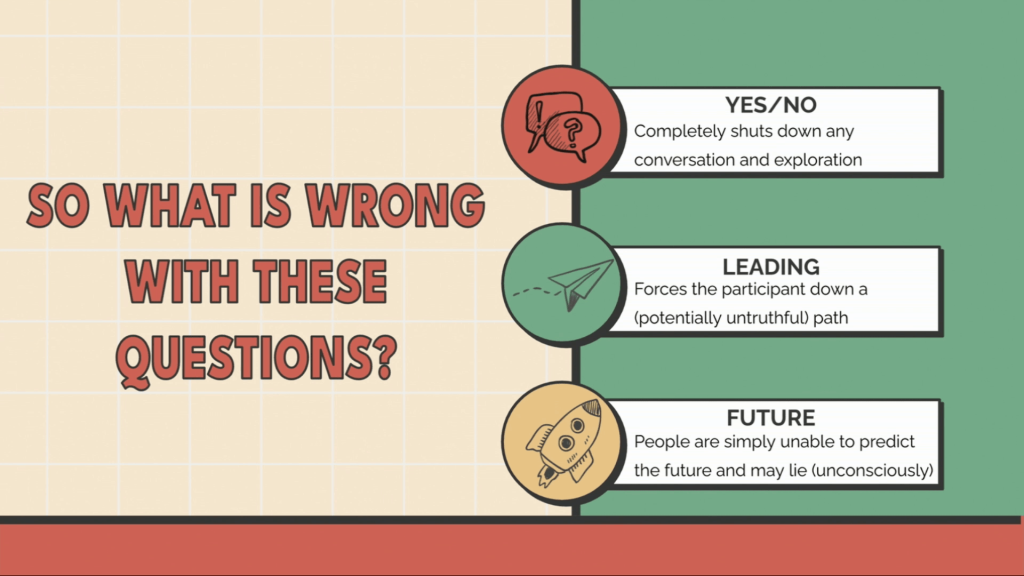
The summary was clear: poor questions produce superficial, misleading insight.
Introducing TEDW: a simple but powerful shift
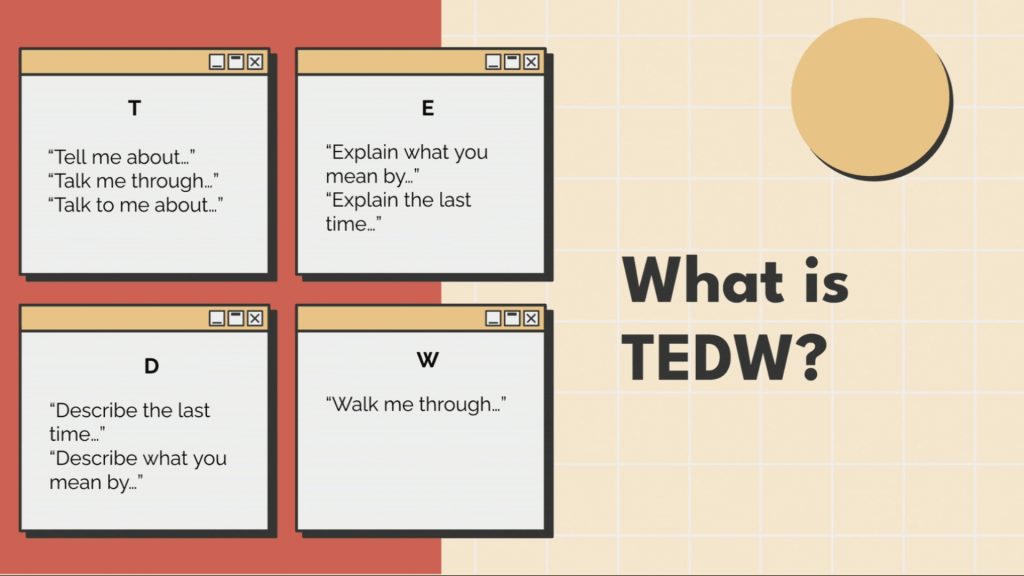
TEDW is an acronym, and each letter represents a prompt that naturally generates open-ended responses:
T: Tell me about / Talk me through / Talk to me about
E: Explain what you mean by / Explain the last time
D: Describe the last time / Describe what you mean by
W: Walk me through
The strength of the framework lies in its simplicity. Rather than inventing complex new questions, researchers can often transform an existing one simply by placing a TEDW phrase at the beginning to instantly create a conversation-starter.
Instead of asking “Did you find the button?”, one might ask, “Walk me through how you would find the button.” Instead of “Do you like this feature?”, try “Talk me through how you feel about it.”
These shifts move from judgment and validation to storytelling and behaviour.
Stories over surface answers
One of the central themes of the talk was the value of stories in research. Rather than collecting opinions in isolation, TEDW prompts participants to recount lived experience.
As Nikki put it:
A central theme of the talk was the value of stories in research. Moving beyond collecting isolated opinions, TEDW prompts participants to recount lived experiences, which provide the context, motivation, and emotion necessary for true insight. They reveal workflows, workarounds and unmet needs. A simple yes/no answer cannot achieve this.
Crucially, the framework also supports active listening. When researchers feel pressure to produce the “next” question, they often stop paying attention. TEDW reduces this cognitive load by allowing the interviewer to simply place a TEDW phrase in front of whatever question forms in their mind. This frees them to focus on what the participant is saying without scrambling to construct a perfect follow-up.
Beyond user interviews
While the talk focused on generative research, Nikki demonstrated that TEDW has much wider applications.
In stakeholder meetings, it can replace defensiveness with dialogue. Instead of asking, “Why did you change the timeline?”, one might say, “Tell me about the challenges you encountered during the implementation phase.”
In career conversations, TEDW can clarify ambiguous expectations. For example:
- “Describe your success criteria for a researcher in this organisation.”
- “Explain how I can better align my current projects with the team’s strategic goals.”
By shifting to descriptive, exploratory language, conversations become collaborative as opposed to confrontational. Nikki even suggested using the model socially, noting that open-ended prompts can transform networking and surface richer personal stories.
At its core, the framework prioritises curiosity over validation.
Conversations are where the magic happens
Throughout the session, one theme remained constant: research is about discussion, not interrogation.
Nikki concluded with a reminder that insight comes from depth, encouraging attendees to revisit their old interview scripts and systematically replace limiting prompts with TEDW-based alternatives. The framework can also enhance usability testing by asking participants to describe behaviour, not just report it.
For those seeking to improve research quality, stakeholder communication, or even career progression, the takeaway was practical and actionable: start by changing the way your questions begin.
To fully grasp Nikki Anderson’s examples, live demonstrations, and audience interactions, including her real-time TEDW transformations, watch the complete video recording and review the accompanying slides below.