
We’ve spent years optimising interfaces, building design systems, and refining user flows. And then, almost overnight, a new question landed on every designer’s desk: what happens when the product talks back?
Designers are no longer just responsible for mockups, they’re shipping entire features. Developers ask about user flows before they write a single line of code. Product managers? Their role is shifting the most. Design tools ship AI features monthly, prototyping now means prompting, and the boundaries between disciplines are dissolving fast. Yet the fundamentals haven’t changed. Users still need clarity. Products still need craft. Teams still ship the wrong thing when they skip research.
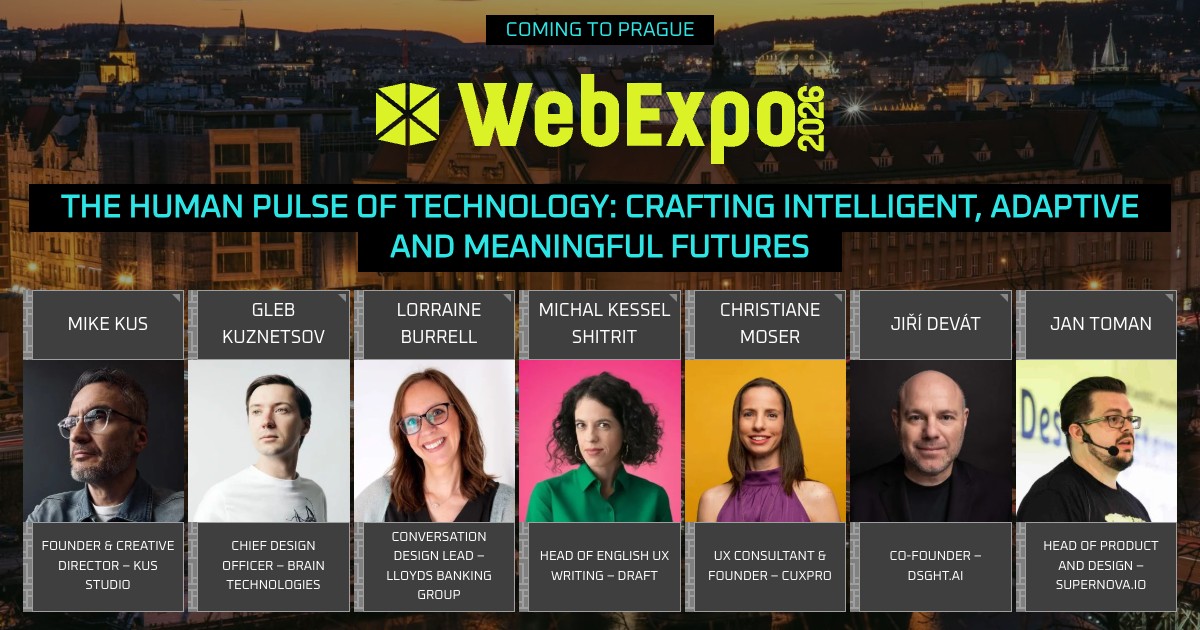
That tension between the radically new and the timelessly essential is exactly what makes WebExpo 2026 feel so well-timed. The lineup of 70+ speakers covers everything from frontend engineering, design and AI to research, business strategy and accessibility. But if you’re a designer, researcher, product manager, or anyone who shapes what people actually experience, here are seven talks I’m most excited about and would personally recommend.

Craft and aesthetics: Why the human touch matters more, not less
In a world where anyone can generate a decent-looking interface in seconds, what’s the value of a designer with taste, instinct, and a point of view? Turns out, it’s everything.
Mike Kus opens the conversation with Design like no-one is watching. His message is a direct challenge to the sea of sameness that safe conventions and templates are creating: rediscover creative instinct, take risks, design with genuine emotion. If you’ve ever felt like modern product design is becoming too safe and too predictable, this is your talk.
Gleb Kuznetsov takes it into the future with Beauty that thinks: The future of meaningful aesthetics. What happens when aesthetics become intelligent: adaptive, emotional, and context-aware? Gleb argues for a shift from app-centric design (rigid, task-driven) to human-centric design that reflects culture, feeling, and real context.
AI meets design: Beyond the hype, into practice
Everyone’s talking about AI in design, but most of the conversation is still stuck at “AI will replace designers” or “AI is just a tool.” These two talks get into the practical work of actually designing with and for AI.
Lorraine Burrell brings Designing the agentic era: Experimentation over magic. AI agents fail not because the technology isn’t capable, but because nobody designed the experience properly. Her talk reframes what “design” means when systems behave autonomously and makes the case for structured experimentation over magical thinking about what LLMs can do.
Michal Kessel Shitrit tackles a problem every product team already faces: Don’t trust the bot: A human framework for evaluating AI copy. AI can generate entire interfaces’ worth of text in seconds, but how do you know if it’s actually good? Michal offers a practical five-principle framework for evaluating AI-generated UX content, showing how to spot problems, refine tone, and decide which parts deserve extra human attention.
Strategy and vision: Measuring impact, designing futures
Great design isn’t just about how things look or how they’re built. These two talks zoom out and address how design connects to business outcomes and long-term strategy.
Christiane Moser presents Product experience mapping: Turning chaos into clarity. How do you connect what your team builds with how your users feel? Christiane introduces a practical approach to define a product-specific canvas, build a clear experience vision, and break it down into actionable parts. For anyone who wants to align cross-functional teams around user experience, not just outputs.
Jiří Devát brings Designing for futures that don’t exist yet. We design for today’s users, but what if the entire product category rewrites itself tomorrow? Jiří introduces strategic foresight: mapping plausible scenarios and making design decisions that hold up against multiple possible futures.
The full picture: A product case study with nothing hidden
Jan Toman closes our selection with Refactoring an entire product from scratch: Stories from the product and design side. Most experts advise rewriting a product gradually. Jan’s team rewrote everything at once, migrating from Flutter to React while serving enterprise customers on a biweekly release cadence, all on the limited runway of a seed-stage startup. Two years later, he’s sharing the unvarnished truth: the migration audit, the “no new features” rule they broke, choosing a component library for their design system, and how they failed at early access. The kind of honest, multi-angle case study that’s rare at any conference.
And there’s much more
These seven talks are my personal picks, but WebExpo 2026 has a deep bench of design-relevant sessions. Oliver Schöndorfer will show how bad typography quietly destroys UX. Johannes Lehner dives into design systems that actually scale. Benjamin Rancic challenges conventional UX wisdom by asking what happens when you intentionally ignore users or make products harder to use. And if you’re into research, don’t miss Nick Fine on evidence-led design and Katherine Corneilson from Wise on qualitative data analysis.
Check out the speaker lineup and program to build your own agenda.