
Part 1 of 4
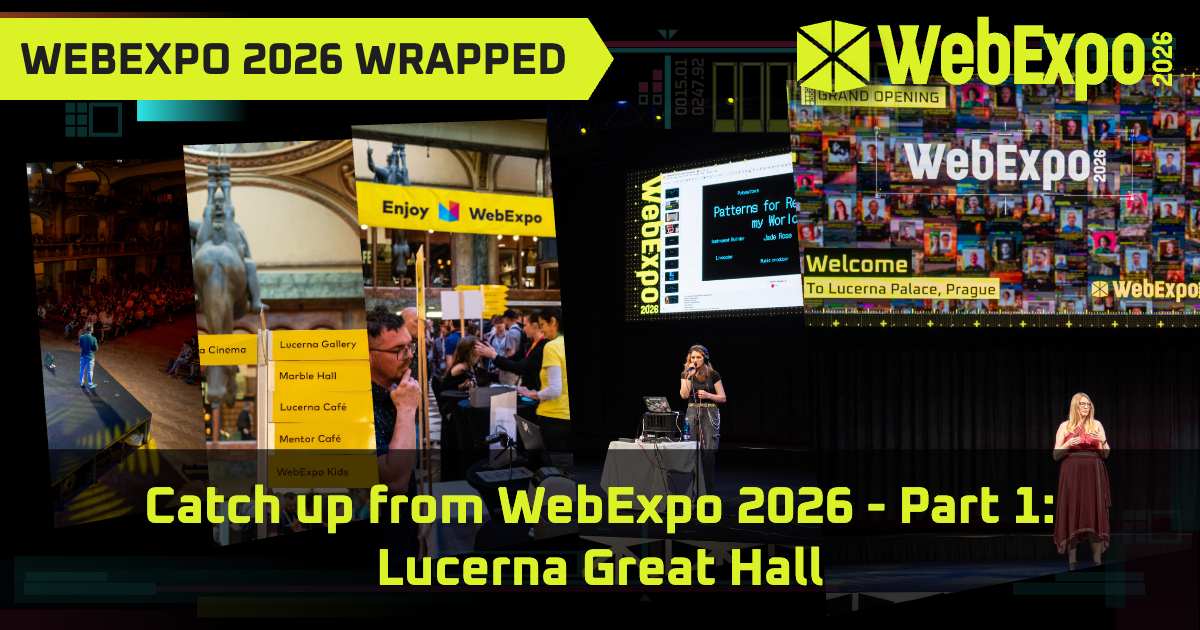
WebExpo turned 18 this year. Old enough to vote, drink and ask the hard questions. The Lucerna Great Hall, our main stage, went straight for the big one: as AI, automation and web platforms accelerate, what still depends on human judgement?
Across two days, the room went from flapping drones in the opening to live-coded music, visual originality, AI governance, software failure, accessibility, security and product evidence. The speakers made the question concrete. No “is technology good or bad” debates. Just how people make, or should strive to make, better decisions when the tools around them get faster.
An event built for people
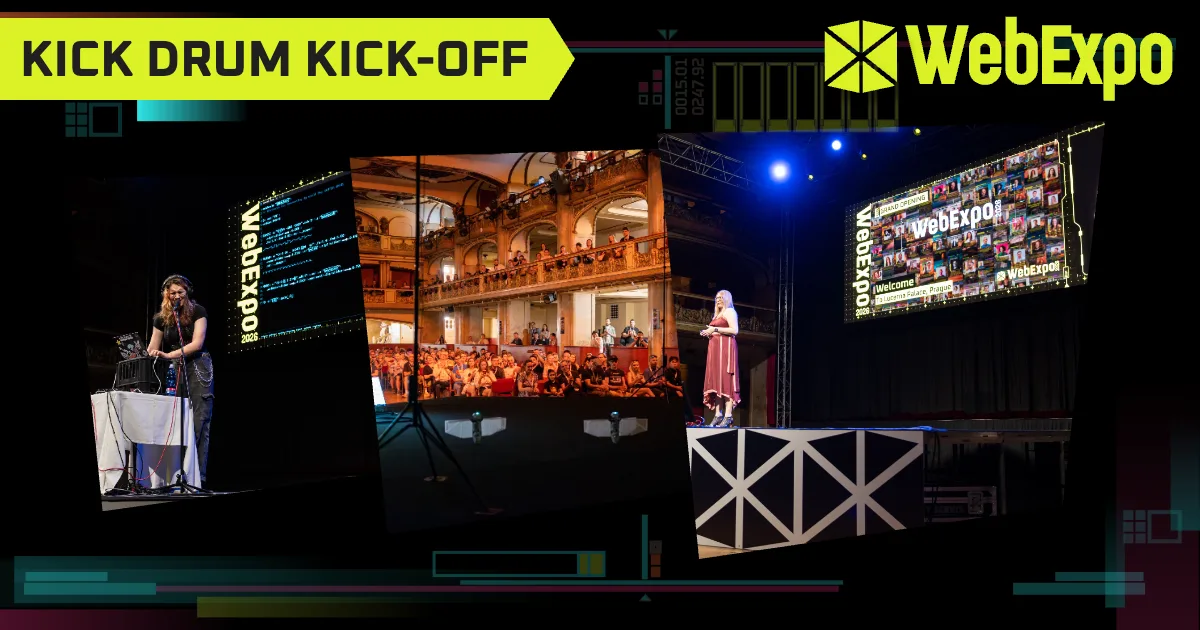
Šárka Štrossová welcomed the attendees and one sentence from the WebExpo Grand Opening could not reflect where we stand more than anything: “The conference exists for people to meet.” The Great Hall was not just a stage for polished talks. It was part of a system that included mentor sessions, speakers’ corners, workshops, hallway conversations and the informal art of comparing notes with other attendees.
The opening keynote pushed against passive technology use. In “Patterns for restarting the world”, Switch Angel treated live coding as music, performance and shared learning. Code appeared not as hidden infrastructure, but as something performed in front of an audience, with risk, rhythm and improvisation. The point was not only that live coding is expressive. It was that tools become more human when people understand them deeply enough to bend them.
The same defence of human agency ran through “Design like no-one is watching”. Mike Kus’s target was not AI. It was the risk of becoming average. Trends, templates and generative tools make work look competent while draining away voice. “Your originality is your advantage.” The line landed because it made creativity feel less like personal branding and more like professional responsibility.
Susan Lindner added storytelling to the mix. “The storyteller’s ROI: Why logic fails and narrative wins” argued that data rarely moves people unless it connects to emotion, audience need and a believable future. Her examples, from public health work in Thailand to presentations that buried good ideas under too much information, made narrative feel like a practical skill. Not a soft one.
I’ve just spoken at @webexpo in Prague – this me making my slides for my talk… https://t.co/4zypEJQJ5l
— Mike Kus (@mikekus) May 29, 2026
P.S. How amazing is this video. Thank you, Mike. Talk about moving!
Creativity meets consequence
By late morning, the mood shifted from expression to consequence. Stanislav Fort’s “Hunting for zero-day with AI” showed how AI can help detect vulnerabilities in codebases. The interesting detail? Smaller models sometimes outperformed larger ones. AI-assisted security only looked useful when tested against concrete weaknesses.
Brecht De Ruyte made the case for native controls, Open UI and modern CSS in “Select it! Styling new HTML UI capabilities”. “UI should be controllable. It should definitely be accessible.” Teams should not have to rebuild basic interface elements with unnecessary fragility just to get styling and accessibility right.
The afternoon delivered the day’s most playful technical moment. Dave Kiss used Three.js, physics and video to build a coin-operated 3D video player in “Insert coin to continue”. Could have been a novelty demo. The engineering was too solid for that. The web, Dave reminded everyone, is still a medium for tactile, strange and joyful interactions, not only forms, dashboards and conversion funnels.
Then the tone widened from individual craft to organisational change. Senta Čermáková described the psychology of AI adoption in “Fossils, Rockets, and Octopuses”: resistance, optimism, unpredictability and leadership pressure, all sitting inside the same company. “Training is not transformation.” A few workshops do not change a culture. Adoption needs leadership, ownership and a clear answer to how far an organisation intends to go.
The first day ended with two reminders that speed has consequences. Daniel Cuthbert’s “From HAL to Replicants” looked at agentic systems, commerce and mischief: “the entire old security model was quietly built on human time.” If agents can discover, exploit, buy and act faster than people, verification and fraud controls need to change too. Nick Fine’s “Stop building on hope” kept the focus on product discipline: many teams do not fail because they cannot build, but because they build the wrong thing. His NFB method was simple: “every feature must trace back to a user need”.
When craft hits the speed test
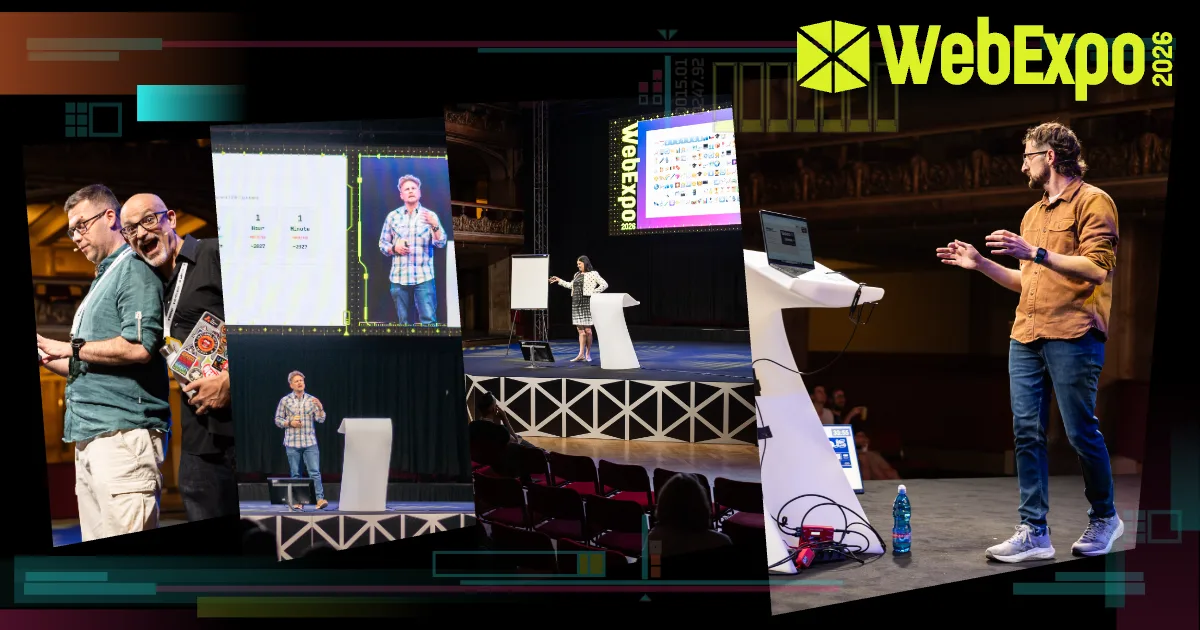
Day two opened with laughter, but not a lightweight message. Krasimir Tsonev celebrated type coercion, NaN and the long list of behaviours that make JavaScript both frustrating and durable in “JavaScript: Weird by design and we love it”. The lesson was humility: the platform is weird, and shallow understanding creates bugs.
Mia Bajić raised the stakes in “The most bizarre software bugs in history”. Some examples were silly. Others involved aviation, medical systems, space missions and runaway pricing loops. Together they made a sober point about assumptions. Bugs are rarely just local mistakes. They are often failures of testing, communication, validation and system design.
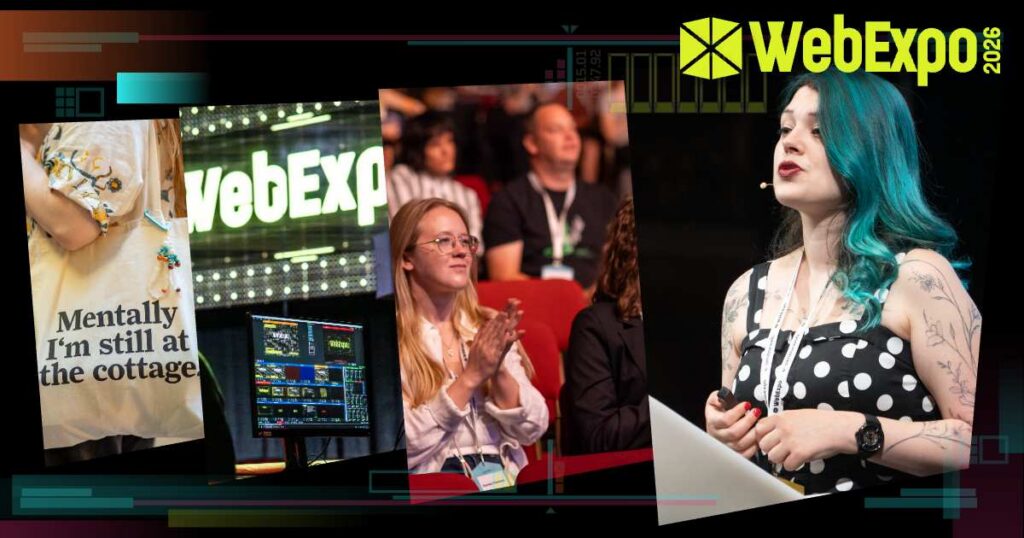
The invisible failures between teams became Christine Vallaure’s subject in “The invisible design divide”. Rather than treating design handoff as a clean transfer, she argued for a shared understanding of layout: Flexbox, Grid, container queries, documentation and the constraints that shape implementation. In a world where AI tools can quickly turn vague design intent into code, that shared language becomes more important, not less.
AI returned after lunch, but with sharper standards. Michal Kessel Shitrit’s “Don’t trust the bot” gave UX teams a plain framework for judging generated copy. “Good copy is good copy.” Whether written by a person or a model, words still need to reduce friction, answer concerns, sound human, open the next step and have a point of view.
Lorraine Burrell pushed that standard into agentic design. “Designing the agentic era” described the move from scripted conversation flows to probabilistic systems, where teams cannot plan every path in advance. “In probabilistic systems, hoping that the model behaves is not a strategy.” Good AI experiences need goals, constraints, content quality and evaluation loops.
The research version of that warning came from Nick Fine’s second talk, “Plausible is not valid”. AI-generated personas can look persuasive while being completely unsupported by evidence. “Plausible does not mean that it’s valid.” Personas should be containers for genuine insight, not polished fiction.
Eric Bailey cut to implementation fundamentals with “What I wish someone told me when I first started using ARIA”. ARIA is powerful but easy to misuse. “ARIA does not create interactivity by being declared” was the line to remember. Attributes can describe expected behaviour, but they do not replace semantic HTML, keyboard support or assistive technology testing.
The main program ended with Tejas Kumar’s “Taste”. Performance, aesthetics, feedback and quality standards came together in his argument that taste is trained, not magically granted. “The difference between AI slop and quality work that is AI-assisted is taste.” Better tools can produce more output, but they do not automatically produce better work.
What were the Great Hall takeaways?
Lessons were broad, but they were not scattered:
- Human originality still matters when tools make competent output easier.
- AI needs evaluation, constraints and ownership, not faith.
- Craft is a safety practice, whether the subject is JavaScript, layout, ARIA or native UI.
- Product work improves when features trace back to evidence and user needs.
- Security and accessibility cannot be added after systems become autonomous or complex.
Šárka returned for Closing Remarks with a reminder about the next day’s workshops, a party invitation and a preview of WebExpo 2027 including Léonie Watson, Vitaly Friedman, Scott Gould and others. It brought the room back to where it started: people meeting, learning and carrying ideas into the next conversation. And tickets for 2027 are already on sale. Just sayin’. 🎟️

The Great Hall gave this series its central argument: faster tools do not reduce the need for judgement. They expose where judgement is missing. Next up, Lucerna Cinema, where the same question gets operational: how teams make environments, decisions, research, funnels and AI adoption clearer before complexity turns into cost.