
Part 3 of 4
This series has made two arguments so far: the Great Hall asked for human judgement; Lucerna Cinema showed clarity as a working practice. Marble Hall put both under pressure. This was the room where work got faster: AI rewriting product roles, agentic software building workflows, analytics becoming recommendations, DevOps compressing deployment time, design systems scaling across teams, and futures thinking stretching product decisions beyond the roadmap.
The surprise was how often the room returned to basics. Faster tools only help if the underlying work is understandable, usable, maintainable and valuable. Marble Hall was future-facing, but its best talks were not intoxicated by the future. They kept asking whether teams had the foundations to survive it.
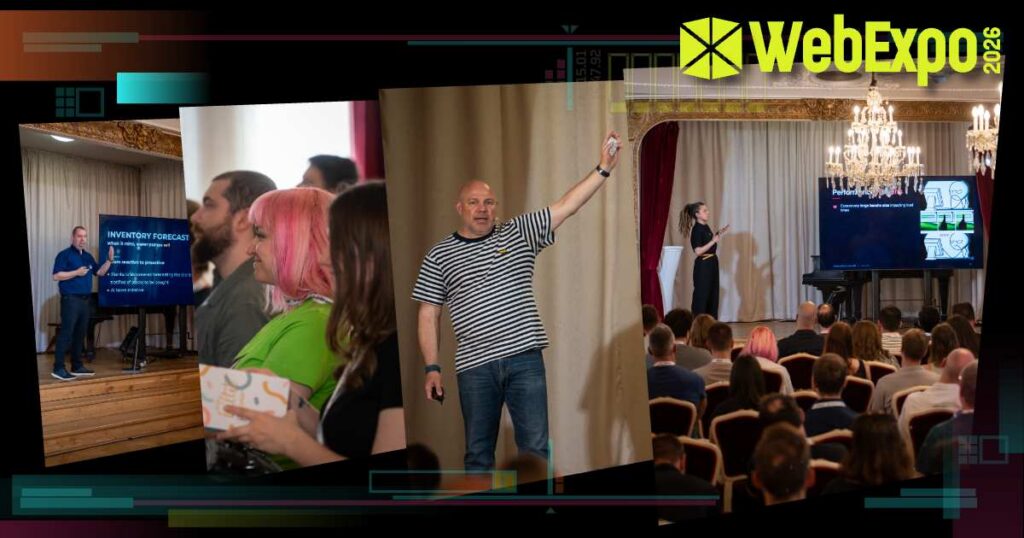
AI expands the builder’s circle
Amit Paunikar set the tone in “The silent rewrite”. AI has already changed product management, often without teams formally acknowledging it. Product managers are moving from information transfer towards orchestration: creating decision frameworks, shaping prompts, coordinating inputs and helping systems produce useful outputs. His COPE framing (create, orchestrate, promote, enhance) made the role change practical rather than abstract.
That practical AI story continued with Šimon Zámečník’s “When AI becomes your data therapist”. The phrase was simple, but the reality is not. “The hard part actually comes with the data,” he said. AI can make manuals searchable, support forecasting and unlock institutional knowledge, but only when the data itself is treated as a serious product material.
Design entered through imperfection rather than polish. Benjamin Rancic’s “How to get design right by doing it wrong?” called out for iteration, perspective and the usefulness of flawed first attempts. Endless effort does not automatically produce better results. Teams should expose problems early enough to learn from them, instead of polishing the wrong direction for too long.
Kate Astrid’s “A real story: Dropping MUI for clean CSS” applied the same thinking to frontend architecture. Moving away from Material UI was not a universal rule. It was a context-specific response to performance and flexibility limits. First contentful paint dropped from 6.6 seconds to 0.8 seconds. The trade-off was visible: dependency choices eventually become user experience. The lessons here aren’t about frameworks; they are about clear decisions.
Designing for change
The room moved from iteration to foresight. Jiří Devát’s “Designing for futures that don’t exist yet” argued for foreseeing rather than predicting. The useful question was not “what will happen?” but “which futures would our product still be valuable in?” Baru Obračajová’s “Futures as a design tool” made that tangible through speculative design, narratives and diegetic prototypes. Together, the two talks treated futures work as rehearsal: a way to practise uncertainty before it arrives.
Accessibility gave the first day its strongest ethical and practical spine. Radek Pavlíček’s “Accessibility by the numbers”. He challenged audit comfort and compliance theatre. “When a website is inaccessible, it’s almost as if it doesn’t exist.” His target was lived usability: can people complete the task?
That question carried directly into Peter Leško’s “Designing for everyone”. His account of accessibility inside Tatra banka’s design system covered research, personas, labels, readable text and component rules. The important part was timing. Accessibility was not a late section in the documentation. It was built into the system and the code before regulation forced the issue.
Anastasiia Gartseva closed the day by making scalability sound almost boring, which was exactly the point of “Why adding 45th theme to your product won’t be a problem”. Design tokens, layered systems, contrast checks and limited overrides make change safe. “Tokens are not just variables. They’re contracts.” The 45th theme should not feel heroic if the system is mature.
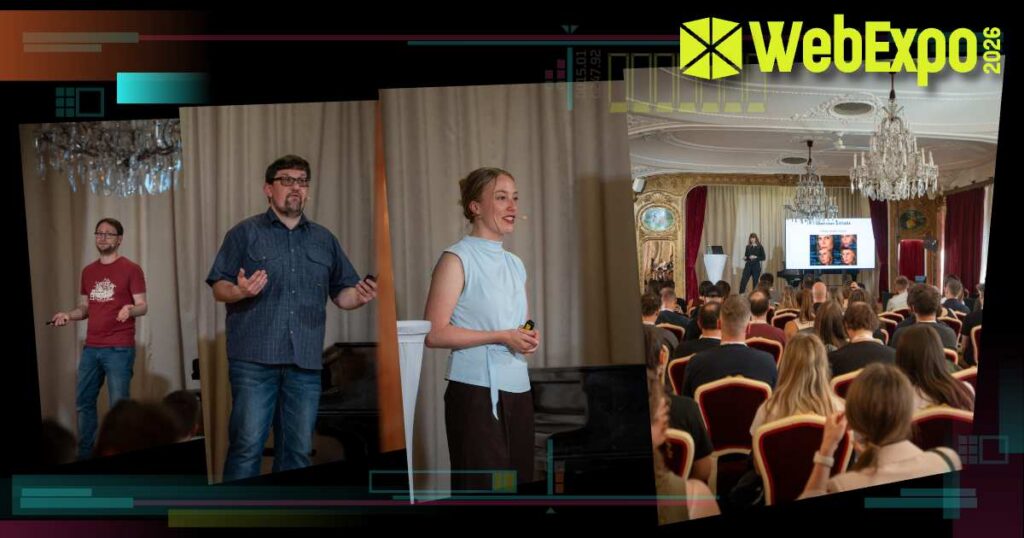
Value, automation and agentic work
Money opened day two. No dancing around it. Dima Melnik’s “Raise the price! You deserve more” approached pricing as a customer problem, not a product vanity exercise. Offers, segments, anchors and language shape perceived value. A product may be clever, accessible or technically elegant, but customers still need to recognise why it is worth paying for. With a lot of laughs along the way.
Peter Trenkner brought product management back to hands-on building in “Non-technical PM building products with AI”. PMs can no longer stay in coordination mode. AI-assisted prototyping gives non-technical people a way to test ideas faster, communicate with working artefacts and shorten the loop between problem and product.
At infrastructure scale, “Extreme DevOps automation” showed Sérgio Amorim confronting a different version of the same speed problem. Revolut’s move towards self-service deployment and clearer platform thinking reduced first deployment time from roughly 50 days to three. The deeper lesson was cultural: teams often resist losing local control, but automation at scale requires common paths.
Of the big calls of the day, a mighty claim came from Jakub Bareš in “How agentic software is pushing the boundaries of what we can build”. “Natural language actually became the programming language.” His examples pointed towards software that can reason through workflows rather than only respond to UI commands. More people can build in that world, but the wider message kept the excitement grounded: building faster is not the same as building well.
Yoav Shmaria held dashboards to the same standard in “Reducing analytics noise with AI”. Leaders do not need more metrics for their own sake. They need clear, actionable recommendations grounded in context. AI’s value here is not volume; it is synthesis.
Systems that can hold the future
The web itself became the system under discussion in Ehsan Toreini’s “‘It’s complicated’: The relationship between user, browser and web developer”. Standards, privacy, accessibility, browser capabilities and developer needs all pull in different directions. His reminder that users sit at the top of the constituency hierarchy gave the audience a governance frame: progress is not progress if it weakens user agency. If you don’t like the direction of the web, get involved.
Elis Laasik made visual judgement practical in “Train your design eye”. Alignment, spacing, sizing and colour were presented as learnable skills for developers. When AI lets teams produce UI faster, the ability to see weak hierarchy, poor spacing or confusing colour becomes more important. And wow, Kahoot! fans really got into this one 🙂
In “Building an agentic competitive intelligence program”, Anja Duricic walked through what it looks like when a non developer starts building with AI inside a functioning organisation. The work involved sales needs, scattered spreadsheets, documentation gaps, access issues and IT dependencies. Sales teams need to know how they compare when named competitors enter deals. Her conclusion cut through the friction: “The barrier is no longer technology or cost. It’s the willingness to start.”
The closing session gave Marble Hall its best structural metaphor. Johannes Lehner’s “Design systems that scale smart” rejected the idea that a Figma file, component library or AI prompt is enough. “A design system is a governed product,” he said. Decisions, contracts, versioning, adoption and maintenance are what make systems scale.
Key lessons from Marble Hall
- AI expands who can build, but it does not remove the need for product judgement.
- Data, design systems and DevOps all become fragile when treated as side work.
- Accessibility is strongest when designed into components, not audited at the end.
- Futures work is useful when it helps teams rehearse uncertainty.
- Scale depends on contracts: design tokens, platform paths, standards and governance.
Marble Hall’s optimism was real, but it was disciplined. The arguments weren’t against speed, but that speed exposes weak foundations faster. Data quality, design literacy, accessibility, pricing, standards, DevOps and system governance all matter more when tools accelerate the work.
After the Great Hall’s judgment, Lucerna Cinema’s clarity and Marble Hall’s fundamentals, the Discomfort Zone asks what all this change feels like for the people inside it.