
Part 4 of 4
The first three WebExpo 2026 Wrapped posts in this series judgement, clarity and fundamentals. The Discomfort Zone made it personal: what do those demands cost people? Tucked into the tight Lucerna Small Hall, it felt deliberately different from the rest of WebExpo: less polished case studies, more honest conversation; fewer tool demos, more attention to mental health, AI anxiety, language, accessibility, boundaries, relocation, management and fear.
That did not make it a side track. It made it the place where the conference’s most human questions were collected. If Lucerna Great Hall asked how we judge technology, Lucerna Cinema asked how teams work clearly, and the Marble Hall asked how systems scale, the Discomfort Zone asked how people stay intact while doing all of that.
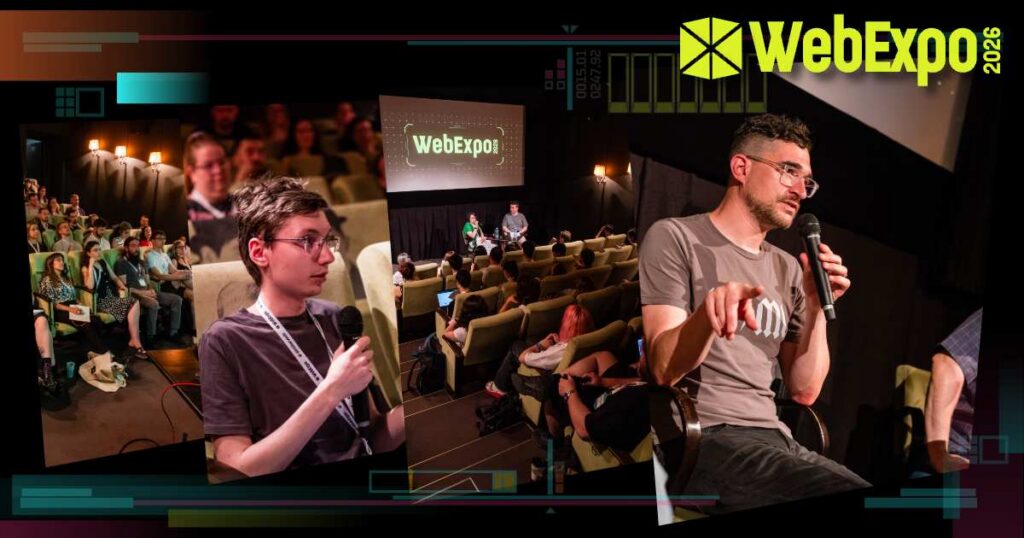
Naming what usually stays hidden
The opening session, “You are going to die”, could have been sensational (especially compared to ‘How to Git away with murder’). In the hands of Zuzana Pešková and Riki Fridrich, it was careful instead. “This is the place where we talk about things that shouldn’t be talked about, but needs to be talked about,” they said at the start. The discussion moved through suicide awareness, loneliness, vulnerability and the isolating nature of tech work. Zuzana’s personal motivation gave the session weight without turning it into spectacle. Riki kept the tone open, sometimes darkly humorous, but always pointed towards support. Twas humble but heavy: listen well, make space for honesty, and notice when the confidence of professional life is hiding genuine struggle.
Career uncertainty followed naturally. Riki and Martin Kopecký challenged the familiar five-year-plan question in “Level up or be levelled”. Technology, roles and expectations move too quickly for tidy scripts. “From my experience, nobody knows what they want to do in five years.” Instead of a plan, they offered a practice: shorter horizons, experiments over certainty, “safe sandbox” work where failure stays cheap, and collaboration across disciplines. The comfort was not in knowing where you are going. It was in getting comfortable with not knowing.
AI, context and the limits of convenience
The AI conversation here was not about enterprise transformation. It was about children, learning and dependence. Václav Šulc and Riki anchored the issue in parenting and education in “Be your AI’s pet”. The worry was not that children will use AI. It was that convenience may remove the effort that creates understanding. The shift, they said, is not “a series of small steps” but “a huge cliff”.
The “Accessibility in practice” panel brought together Radek Pavlíček, Eric Bailey, Irena Zatloukalová and Johannes Lehner. Eric pointed out that “you can have like a 100% lighthouse score, but the product can be functionally not able to be operated” in a key way. Irena stressed that what helps one person can create obstacles for another. Johannes brought attention to design distraction and first impressions. Radek kept the conversation grounded in practice. Compliance was not enough; people have to be able to use the thing.
Václav Hodek and Riki gave the track another example of context that tools miss in “Tower of Babel in the era of AI”. Václav burst the English-speaking bubble common in technology. Translation is not word replacement. It involves idioms, dialects, culture, product terms and audience expectations. “The context is the most important word here.” AI can make translation faster, but it cannot remove the need for humans who understand meaning.
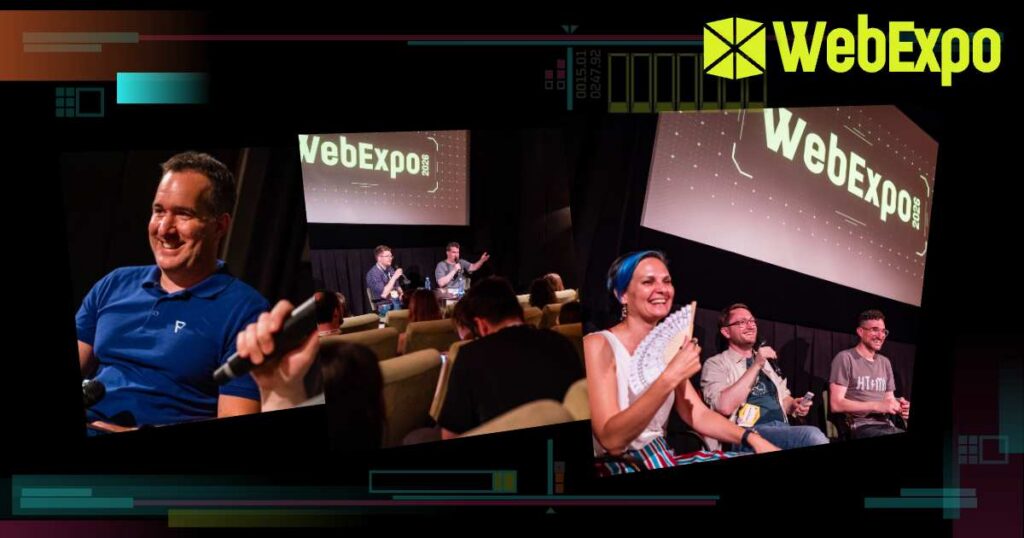
Boundaries, safety and leadership
The strongest personal operating lesson came from Petr Žáček and Riki’s “Personal limits: find them, set them”. The discussion dealt with people-pleasing, identity, burnout and the uncomfortable act of saying no. “No is an option.” Petr called AI “the ultimate sycophant”, a system that mirrors and affirms without contradicting you. If people do not know their own boundaries, both workplaces and tools can pull them further than they intended.
Later in the afternoon, “Running to safety“ widened discomfort beyond the workplace. Riki and Yoav Shmaria spoke about conflict, relocation and the emotional contrast of moving from Israel to Prague. “The Czech Republic is dramatically calm.” captured the difference, but the session’s deeper subject was hidden stress: the background pressure of geopolitical instability while trying to work, parent, and build a life.
The final session, “A Lovecraftian descent into management”, turned discomfort towards leadership. Riki and Alina Medintu used the Lovecraft metaphor well: management gives people access to information and pressures they cannot always unsee or share. The discussion covered empathy, transparency, context filtering and the soft skills that technical careers often underprepare people for. Leadership was not presented as certainty. It was a change in responsibility.
Key lessons from the Discomfort Zone
- Discomfort is useful only when held in a safer space; stress and harm are not virtues.
- AI literacy has to include judgement, boundaries and learning, not just tool use.
- Accessibility, translation and management all fail when they optimise for abstractions instead of people.
- Career adaptation works better through experiments than rigid five-year scripts.
- Saying no can be a professional skill, not a personal failure.
The Discomfort Zone refused to romanticise pressure. War zone stress, suicidal ideation, burnout and loneliness are not conference metaphors. They are real human conditions. The useful discomfort was the kind created by naming taboos, questioning defaults and admitting that systems fail when they ignore the people inside them.
The Small Hall changed the meaning of everything that came before it. The Great Hall’s call for judgement, Cinema’s demand for clarity and Marble Hall’s insistence on fundamentals all depend on people who have enough safety, context and self-knowledge to practise them. This recap series ends not with a tool or a trend, but with a reminder: digital work is still human work first. 💙